


IN CONVERSATION WITH
Ugo Rondinone
by Renata Mosci Sanfourche
It is both difficult to imagine and impossible to ignore that Ugo Rondinone’s Harlem home was once a working church. Today, the space stands as a living expression of his practice—a harmonious interior born out of the contrasts of the world outside. Yet it is precisely within this threshold, between the profane and the sacred, the dark and the light, the inner and the outer, that his home comes to life. “The space becomes a place where these opposites are allowed to coexist, reflecting the complexity of being alive,” he said. Throughout the 20,000-square-foot building, Rondinone juxtaposes an immaculate collection of artworks. Pieces by Sarah Lucas, Valentin Carron, Hans Schärer, Alan Shields, Latifa Echakhch, Peter Halley, Urs Fischer and Cady Noland, among others, form a meditative symphony on the human condition, a score that resounds throughout Rondinone’s practice.
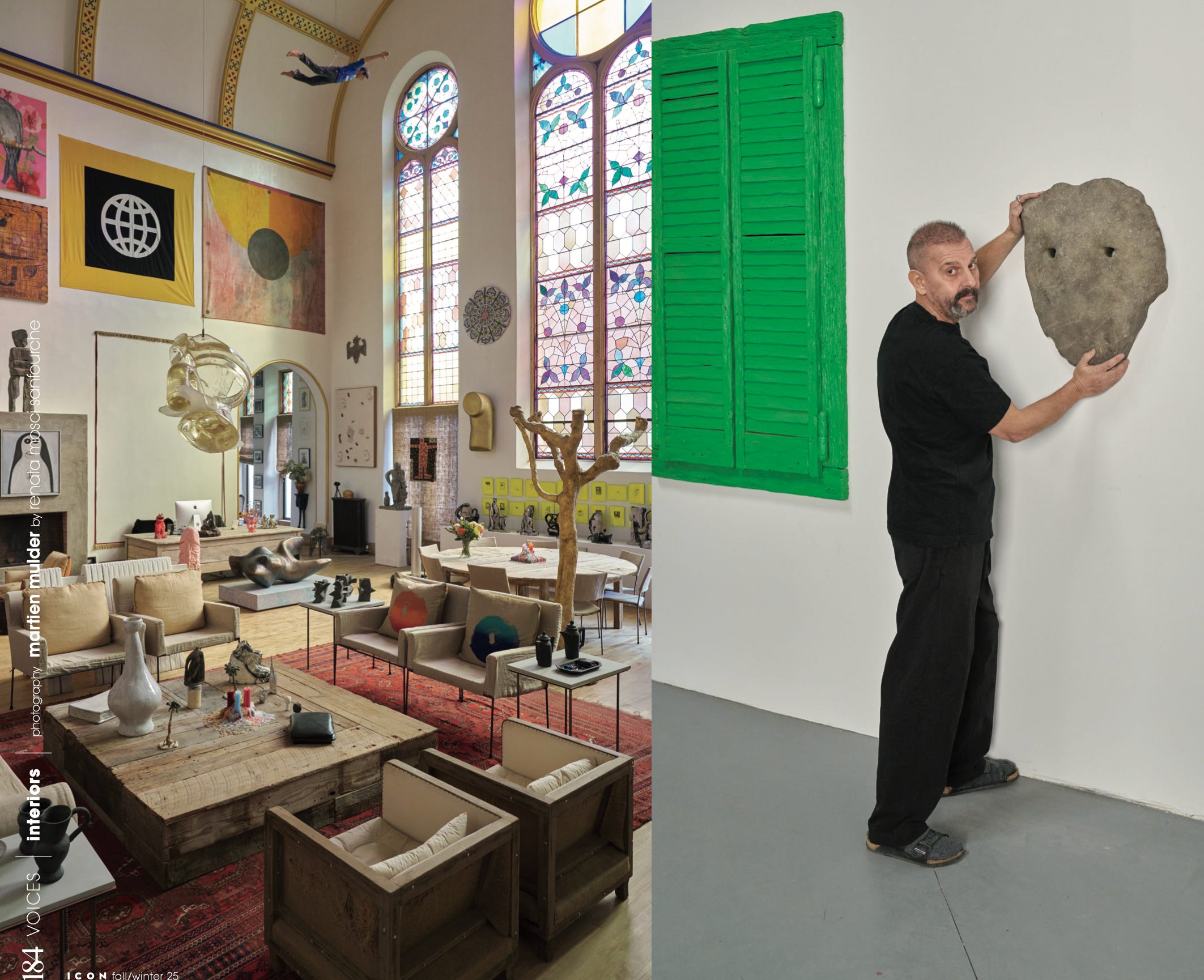
You’re driving through Harlem when you spot a Romanesque church with a for-sale sign. What goes through your head? What seduces you?
It was a rainy Sunday in April 2011. My lat e husband, John Giorno, and I were driving from upstate New York into the city. We had made this drive nearly every weekend for years, but that day we took an unusual route—through Harlem instead of the FDR—to reach downtown. That’s when we saw the sign. We stopped and took a photo of the contact number. The next day, I called the agent and requested a site visit. The church was in poor condition—abandoned for five years and recently foreclosed. A week later, I returned with an architect to assess what it would take to bring the building back to life. The numbers made sense, as did the price. I sold my downtown loft and used the proceeds to purchase the church. We renovated for two years, and I moved in March 2013.
In 2012, you built a live-and-work house in a forest clearing near Zurich, Switzerland. You referred to it as a gesamtkunstwerk, meaning a total work of art. At what point does a house also become an artwork?
A house becomes an artwork at the moment it stops being only a container for life and starts actively shaping that life. For me, it happens when architecture, light, time, objects, rituals, and the surrounding landscape are composed with the same intentionality as a sculpture or an installation. It is a gesamtkunstwerk because nothing in it is neutral: the proportions, the materials, the silence, the forest outside, the rhythm of days and seasons. Living there is not separate from making art; it is part of the work. The house holds memory, labor, solitude, repetition, and care. It asks you to slow down, to be present, to listen. At that point, the house is no longer just functional—it becomes a lived sculpture, activated by time and by the body moving through it.
When you decided to invest in this church—renovate and curate its spaces—did you view it as a challenge, or is inhabiting and transforming places a natural process?
Building and renovating have always felt natural to me, almost instinctive. My father was a stonemason, and as a young teenager I spent Saturdays helping him hand-shape stones for river-stone dry walls. Each stone had to be lifted, examined, and gently altered with a few deliberate hammer strikes until it found its place within the larger structure. That early experience taught me that transforming a space is not about force or domination, but about listening, understanding what already exists and guiding it toward balance and cohesion.
How does your approach change between architecture projects and art installations for museums and institutional spaces?
I do not experience a clear separation between architecture and art installations. For me, both are practices of holding space. They are ways of framing emptiness, light, and time so something can unfold within them. Whether a space is inhabited daily or encountered briefly, my concern is the same: how it receives the body, how it shapes attention, how it allows silence, vulnerability, and reflection to exist. Architecture extends the encounter over a lifetime; an installation condenses it into a moment. But both are ultimately about creating conditions for presence. On your website, we can filter your work between ‘day’ and ‘night’. These contrasts are important in your world where we’re often juggling the perception of the inner versus the outer, the natural versus the man-made, the sacred and the profane, and so on.
Was it important for you to create this type of contrast in the Harlem space?
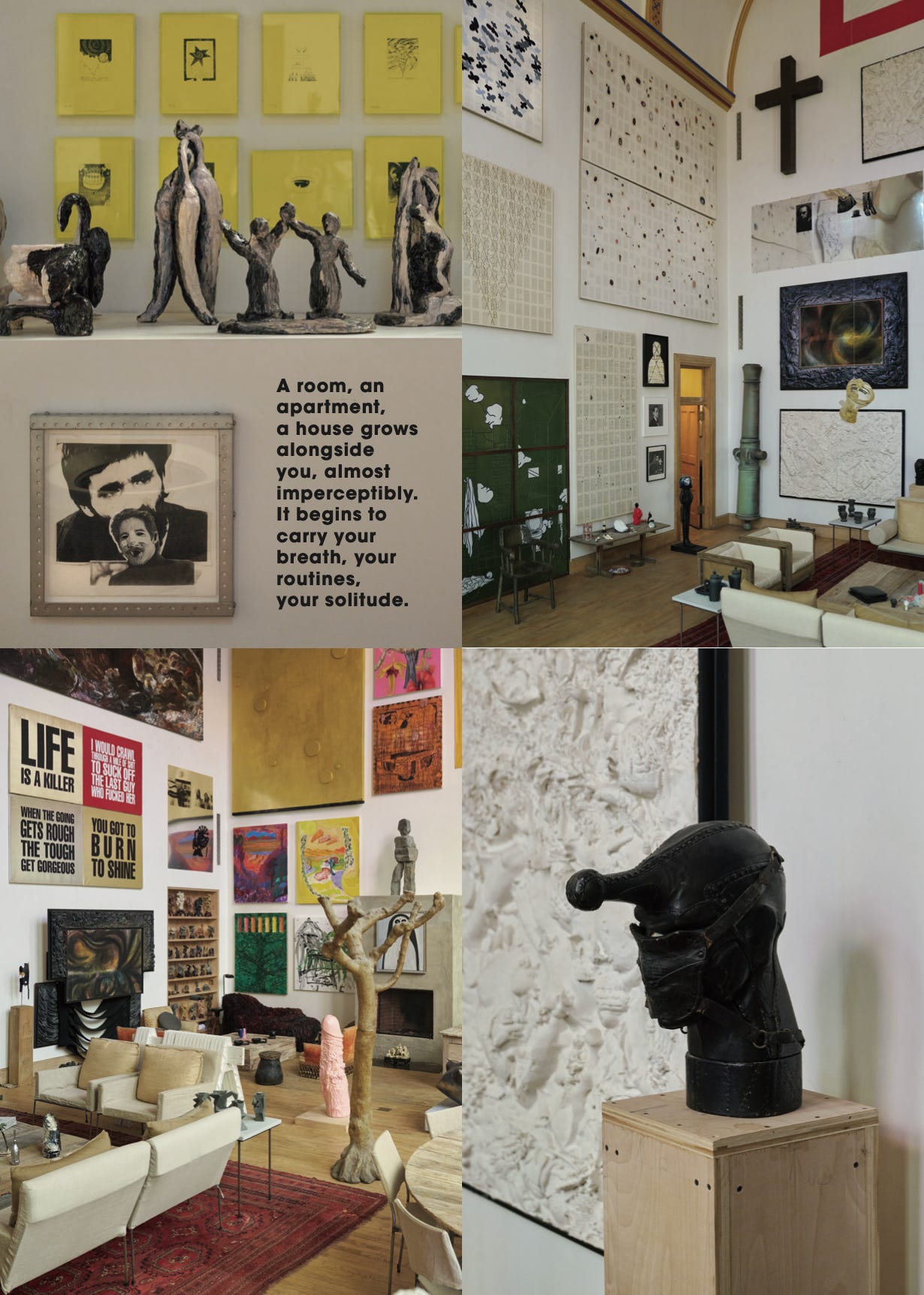
That contrast continues naturally in the way I organize artworks by other artists within the living space. I am drawn to polarity as a way of creating awareness to overcome the common value system of good and bad. In the Harlem house, one wall holds darker, more sinister works, while the opposite wall gathers pieces that are luminous, open, and bright. The two are not in conflict; they exist in dialogue. Living between these poles heightens perception, it mirrors the oscillation between inner and outer states, between vulnerability and affirmation. The space becomes a place where these opposites are allowed to coexist, reflecting the complexity of being alive.
What do windows represent in your work? Is there any relationship between them and the stained-glass windows we see on the church’s facade, or the Urs Fischer glass in the bathroom? Was your recent exhibition “The Rainbow Body” at Sadie Coles HQ in any way inspired by this Harlem property?
The window has always functioned as a metaphor for both revealing and obscuring. This idea goes back to my very first exhibition, where I presented four large ink landscapes while the gallery windows were boarded up. Visitors were deliberately cut off from outside reality so they could fully enter the artificial, constructed world of the exhibition.
Like in Romanticism, my window sculptures operate as vehicles of longing and desire, thresholds through which emotions, memories, and projections are cast into an unknown future. They frame absence as much as presence. In that sense, the stained-glass windows on the church facade and the Urs Fischer glass in the bathroom are not decorative elements, but extensions of this ongoing inquiry into light, distance, and interiority.
“The Rainbow Body” continues this investigation, not as a literal response to the Harlem property, but as part of the same sensibility: a sustained reflection on perception, transformation, and the fragile boundary between inner experience and the world beyond.
You’re one of the first to collect Franz West’s furniture and they’re prominent pieces in the church. What caught your attention in them and how do they make you feel?
My relationship with Franz West began in the late 1980s, when I was studying in Vienna. What started as an artistic connection slowly grew into a friendship rooted in shared conversations about art, life, and vulnerability. In the 1990s, we began exchanging works, which felt less like collecting and more like an ongoing dialogue between our practices.
His furniture always resonated with me because it refuses hierarchy. It is neither purely sculpture nor purely functional object, but something in between—awkward, intimate, human. Living with these pieces, they activate the space in a very physical and emotional way. They invite the body to participate, to rest, to linger, while also carrying the presence of Franz himself. They make me feel accompanied, grounded, and gently unsettled, reminding me that art can be humorous, fragile, and deeply alive all at once.
How did this Harlem home evolve with you over the years?
A room, an apartment, a house grows alongside you, almost imperceptibly. It begins to carry your breath, your routines, your solitude. The Harlem home has changed as I have changed—it has held moments of joy and grief, periods of intense work and quiet withdrawal. Over time, it became less a place I shaped and more a place that shaped me in return. It stands as a private testimony to a life lived from within, marked not by events, but by presence.
Many years ago one could say it’s unexpected to find a Swiss-born living in Harlem. It may still be something unexpected. What do you like about Harlem and how do you interact with the neighborhood?
Harlem has always been a place of transformation. Since its founding, it has continually reinvented itself—shaped by successive waves of inhabitants and cultures. Once a predominantly white Protestant neighborhood, it later was home to large Italian and Jewish communities before emerging as a center of black cultural life during the Harlem Renaissance, and continuing to evolve into the diverse, multiethnic neighborhood it is today, with Hispanic, Black, and white residents living side by side.
This constant change is not an exception, but part of Manhattan’s deeper character. Its neighborhoods are never static; they shift, adapt, and renew themselves. I find that vitality deeply compelling. Living in Harlem means inhabiting a place where history is layered rather than erased, where cultural memory coexists with everyday life. My relationship to the neighborhood is grounded in that awareness—being present, attentive, and respectful of the rhythms and histories that continue to shape it.
Wonderful I love it. Someone I’d like to know.