


In this week’s newsletter: Tao Lin shared a series of English typos in Taiwan slogans, a video interview with Karl Jaspers, Flannery O’Connor’s secret talent, a chronicle I wrote, and more.
CHRONICLE
My Week With Florence
“I looked long.”
— Henry James, Italian Hours
When I was in Florence the weather was warm and comforting and promising, an invitation to the cool hallways of the city’s stone buildings. While we stood on the bridge over the Arno, the breeze drew a clean line between the blue sky and the yellow light on the river. It was a setting for another time. And there was a castor swimming in the water, more than one, the French pointed to them with pleasure.
We walked next to the Arno, in the narrow stone roads that open to bright piazzas where Dante once stood. We saw Caravaggios, Michelangelos, Botticellis and the few Rembrandts my husband found scattered in the Uffizi. Then we passed by groups of people stopping for pictures in front of the Duomo, and we stopped too. And it still felt like we were in another time.
When I arrived at the Monastery of San Marco, a friar held my hand and walked me through the complex. You may think I’m exaggerating, but I felt their spirit in the library, I heard their noise in the refectory. I listened to them, to the swifts screaming in the courtyard, I watched the light drop to the floor and I cried, for it was all too powerful, too sensible, it was my time, my time to see what Angelico saw, my time with the divine.
I believe there are certain places we go where time has been waiting for us, moments that were set aside for us.
There are questions I can’t answer when I reproach God, but I couldn’t see this before. When one is taught religion, or inherits a set of conventional practices, they’re inclined to perceive only its pain. There are so many answers we can only find if we ask for them in spirit.
I find myself time and again reading novels and watching films that evoke more than our mundane conditions. I used to think it’s because this is all I know, but I’m coming to realize it’s because the answers I seek only exist in the place I’ve rejected for years.
The world becomes fairly simplistic when we see demons and feel angels. I’d like to see the sweetness of cherubs, feel the roughness of the devil. I can’t cherish living outside this complexity. I cannot understand without this dichotomy, for it’s all I’ve known that has meaning. And when I try to seek without it, to exist ignorant to its parameters, I find myself in a void.
I know through great writers that the void is in the depths of hell. I thought books would teach me the way out. Instead they showed me the path to resolution is in the mystery of my own beliefs, in the practices I find to circumvent idolatry.
TOP SHELF: ADDED TO THE PILES
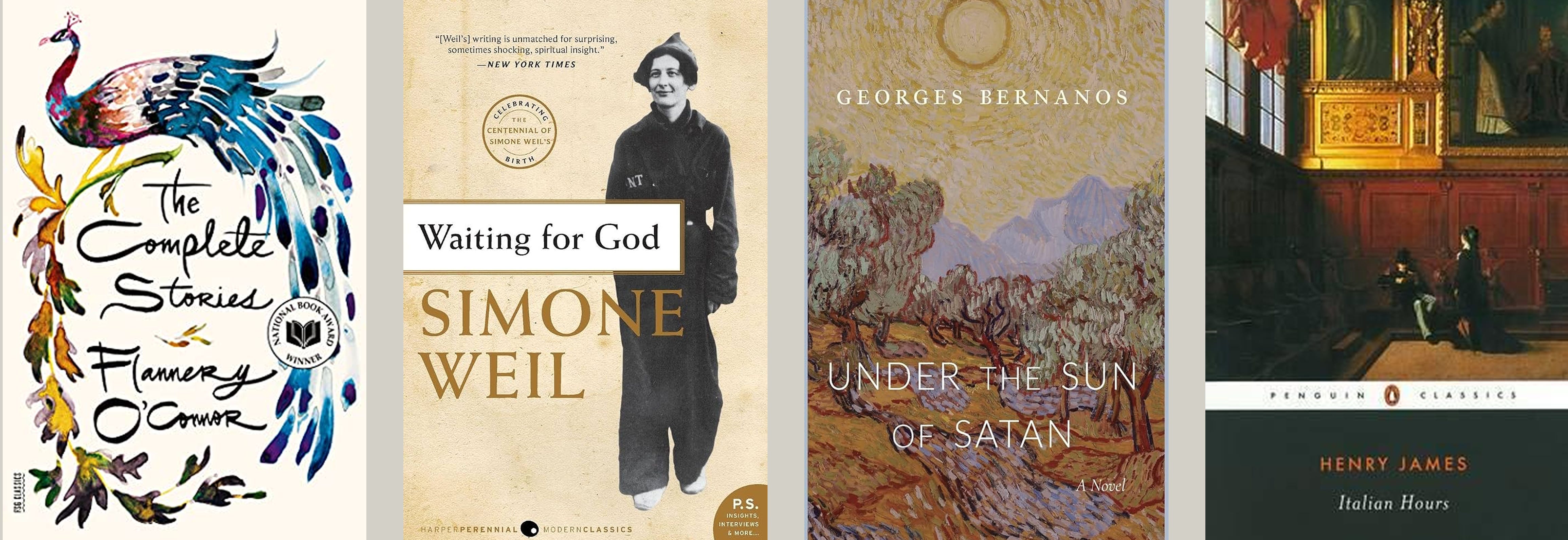
I recently read an essay by Flannery O’Connor, The Fiction Writer and His Country, and I decided to revisit her work. I’m leaving on Sunday on a weeklong trip with my daughter and I think The Complete Stories has an interruptible format that will survive the occasion. I have to remind us that O’Connor taught chickens how to walk backwards when she was only five years old, my daughter just turned five. Who knows what we’ll be inspired to do next week in the countryside. After reading Simone Weil’s, An Anthology, a succinct introduction to her thinking, I’m now starting on Waiting for God. Pialat adapted his greatest film from Georges Bernanos’ novel Under the Sun of Satan, which my husband promised to read with me. And finally, after a beautiful weekend in Florence, I’m trying to stay in Italy by slowly reading through Henry James’ Italian Hours. The collection gathers centuries of his travel writings and notes.
VISUAL LIBRARY


A VIDEO
Karls Jaspers: A Self-Portrait
ARTICLES I READ RECENTLY
In Granta, a conversation about God with Merve Emre, Marilynne Robinson and Jon Fosse. Read
If you read the piece in the New York Times last week about the Trump administration’s never ending persecution of elite universities, you know they’ve chosen Yale as their next target. In the Nation, Yale student Zachary Clifton writes about the university’s efforts to keep the government at bay, and how their plan is failing them. Read
The university’s lobbying expenditures, around $100,000 per quarter during previous administrations, climbed steadily as the Trump administration tightened its grip on elite higher education. Eventually, Yale’s quarterly spending on lobbying reached $370,000, the largest sum spent in the Ivy League.
I’m just as hooked on Misha Glenny’s In Our Time podcast as I was when Melvyn Bragg was hosting it. This week’s episode was on the evolution of trees. If you subscribe, you get early access to an entire episode on Machado de Assis, out July 9. Listen
In the LRB, Adam Thirlwell reviews Reminiscences of Tolstoy, Chekhov and Andreyev by Maxim Gorky (which Fitzcarraldo has just recently reprinted). Read
Turkish author Merve Emre also interviewed László Krasznahorkai for the New Yorker. Read
Taiwan English by Tao Lin in the Paris Review. Read
ESSAYS I RECOMMEND
Reflections on the Death of a Porcupine by D.H. Lawrence. Read
The Pleasure of the Text by Roland Barthes. Read
Negative Capability by John Keats. Read
The Philosophy of Composition by Edgar Allen Poe. Read
American Ephemera by William T. Vollmann. Read
CURRENTLY AT RUE DE CHABROL
Vita’s Bedtime Story
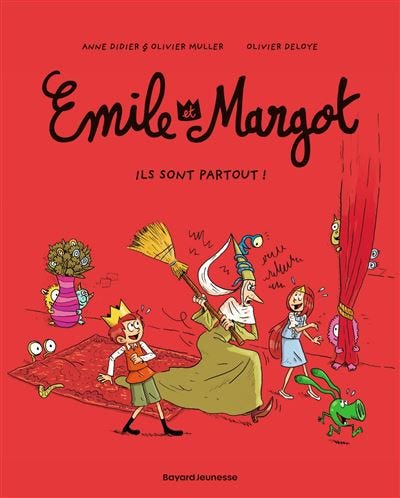
I remember when I was kid and I could hardly pass a newsstand without asking my parents to buy me comics. I was a bit older than Vita, but I loved the Brazilian comics by Mauricio de Sousa. Vita loved this French series called Émile et Margot, and it’s quite cute. It tells the stories of a brother and a sister, who live in a castle, and each day have an adventure with the very nice, and extremely funny, monsters who live in and around the castle. Monsters are everywhere: inside paintings, in the forest, in the rug, and underground. I get why she loves it and I get a kick reading them to her (as she corrects my French, of course).
What My Husband’s Listening To
DJ Screw Originals (Volume 1) by DJ Screw
A Movie I’m Thinking About
The Sacrifice by Andrei Tarkovsky
A POEM
Of Mere Being by Wallace Stevens
The palm at the end of the mind,
Beyond the last thought, rises
In the bronze decor,

A gold-feathered bird
Sings in the palm, without human meaning,
Without human feeling, a foreign song.

You know then that it is not the reason
That makes us happy or unhappy.
The bird sings. Its feathers shine.

The palm stands on the edge of space.
The wind moves slowly in the branches.
The bird's fire-fangled feathers dangle down.