


In this week’s newsletter: In Our Time is back with a new host and an episode on John Stuart Mill, David Brooks wrote his final column for the New York Times, Carl Phillips has a new essay in the Yale Review, and Richard Rorty on culture. Plus a visual library and a chronicle I wrote.
Chronicle
My Protagonist
You can feel when people have lost faith in you. When their words aren’t as gentle as they once felt, when they look at you in despair, unsure which eye to fix their gaze upon. When you speak, they stare at your lips. Your words aren’t void of meaning, but they do weigh less on their minds.
I don’t dream, I don’t have stories to tell, I have no convictions. I’m failing at my own perceptions. I tell myself, it’s not for me to worry about the other’s regard, it’s for me to look further out, so far beyond to a place where their gaze cannot meet mine. It is for me to catch my own shadow, the one I’ve lost faith in, to watch it, tie it away next to me.
Certain days I remember my head resting on my little pillow and you moving into my dreams, casting yourself in front of the light. You remind me of chalk, you are large and round and you chased me in a diagonal line, dust balls rolled around us. Now you chase me in plain daylight, when I think I’m most awake, when I leave my desk to drop off the dry cleaning, when I leave my desk to pick-up veal and ham from the butcher. During the day, when the alarm stops sounding you appear.
I believe I’m coming closer to you now, step-by-step, like a cat hunting rabbits in the grassland. This is the fight you want. When I catch you I discover you’re dry. I find clarity when you feel lost. I’m here, I exist and you don’t, and I know what it feels like to be you, to cross the streets, to get in the way when I’m reaching for something greater than your answers can provide.
Even if I’m blind to your beauty I still see you, so I’ll write you into something. How I’d like to see your eyes shrink when the sun gets too bright.
I’m strong enough now to push you to the side and watch you from the center. Today I become your shadow and you my protagonist. I will torture you, I will turn you around like a beetle in the grass and watch you move your legs back and forth in despair. I’ll make you face agony and I’ll ask you to recover. You will forget yourself, you’ll let me walk between you and the sun now. You will lie there dry as sticks, but I am not God, I’m not in control, you are. You do as you will, with your will and your reason, I give you only conditions. You are a woman. I will not show you what that means, you will discover it.
Why do I want to abuse you? Why do I want to torture you? Are you worthy of something better? Will you lose faith? At the end of this, I will be but a name and you will have inherited the world. You will want to go back to the blackwater river and paddle the Amazon looking for everything you’ve lost, but the forest won’t give it to you. You will have to find something new. We regenerate like dry trees, but never do any of us return to seeds.
New Books
Why I’m Buying These Books
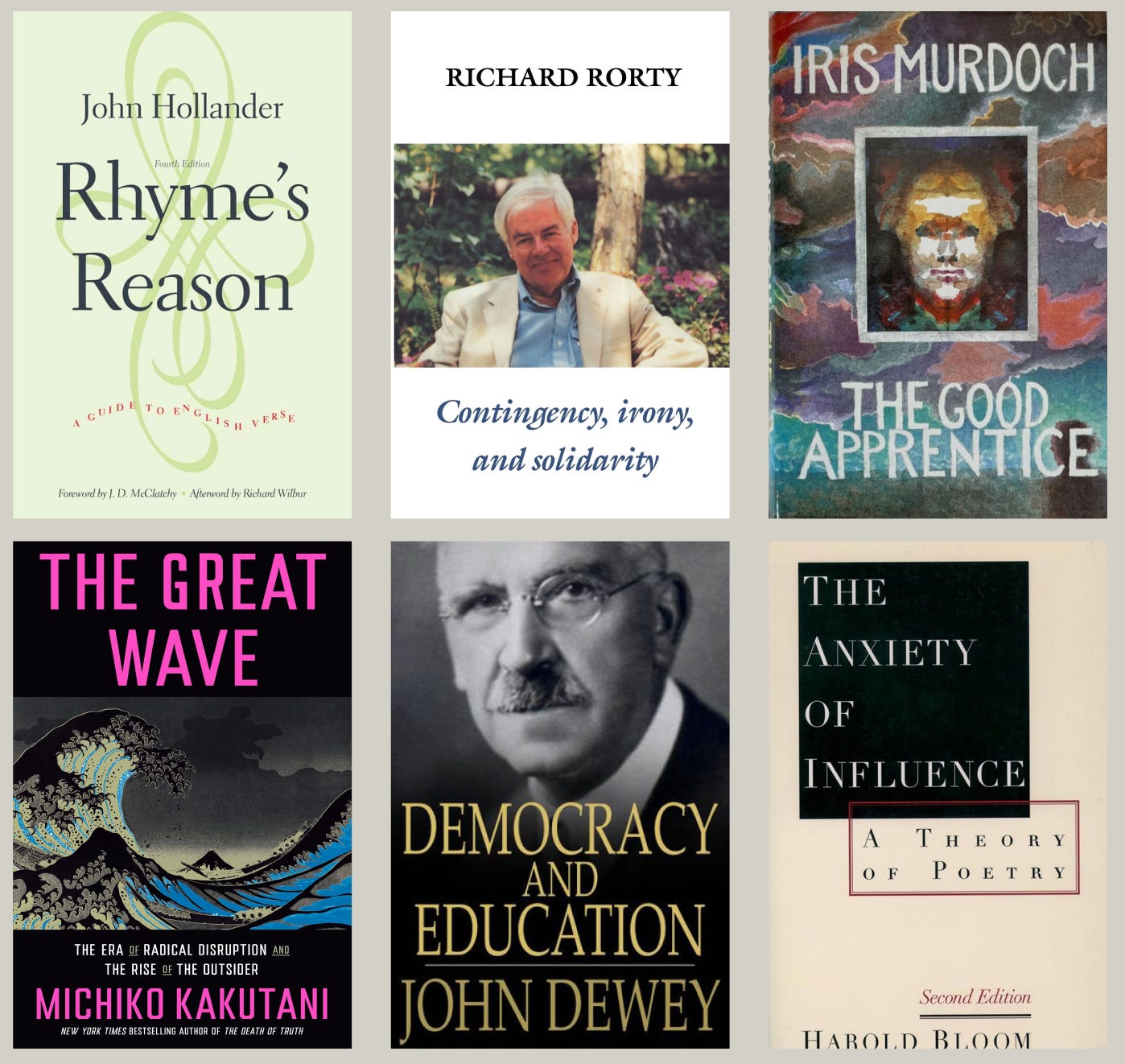
Rhyme’s Reason by John Hollander
Because I read an article this week (which I link below) where the American poet Carl Phillips refers to this book as his introduction to poetry. Although I love poetry, and came to it by way of a Stéphane Mallarmé poem that touched me profoundly, I never studied it and I don’t understand its mechanics. I’d love to discover what he discovered in Hollander’s guide.
Contingency, Irony, and Solidarity by Richard Rorty
Because I listened to a 1990 lecture (which I link below) by the American philosopher and historian Richard Rorty, and I identified with his perspective on contemporary society’s moral and social progress.
The Good Apprentice by Iris Murdoch
Because she deals with humor in both a literary and entertaining way, and I find this to be a difficult combination to achieve. She’s also concerned with religion and I’m interested to see how she deals with spirituality within this context. To be honest, I had forgotten all about her until someone on Substack (I’m sorry I forgot who it was) posted a note about her and it prompted me to read her again, it feels like the right time for me. I listened to several interviews with her on YouTube, and I found she has a very unique perspective on literature and philosophy.
The Great Wave by Michiko Kakutani
Because I really enjoyed reading her book reviews and I went looking to see what she was working on recently and came across this book. I’m fascinated by the idea of the outsider and I’m curious to see how she places them as influential people in contemporary society.
Democracy and Education by John Dewey
Because I’m invested in constantly learning about the state of literary education and I’m curious to read John Dewey’s perspective from the early 20th century. Everything I’ve read by Dewey feels extremely contemporary and relevant to the issues we’re facing as a society today and I undoubtedly believe this is the case with this work:
As the American population appears increasingly subject to rhetorical manipulation and ideological extremism, Dewey imagines the possibility of education cultivating "habits of mind which secure social changes without introducing disorder.
The Anxiety of Influence by Harold Bloom
I already own this one but I think it’s time to reread it. It has come up numerous times this year, and I think it can help push me forward. Each time I read this book it’s as if he was sitting in a room talking to me and helping me get over whatever hurdle I’m undergoing at that moment. There’s so much instruction inside that I couldn’t possibly not revisit it multiple times throughout my life. Each time I discover something else that enlightens my creative process.
The Visual Library
Portraits


Currently at Rue de Chabrol
Seven Articles and One Podcast I Recommend This Week
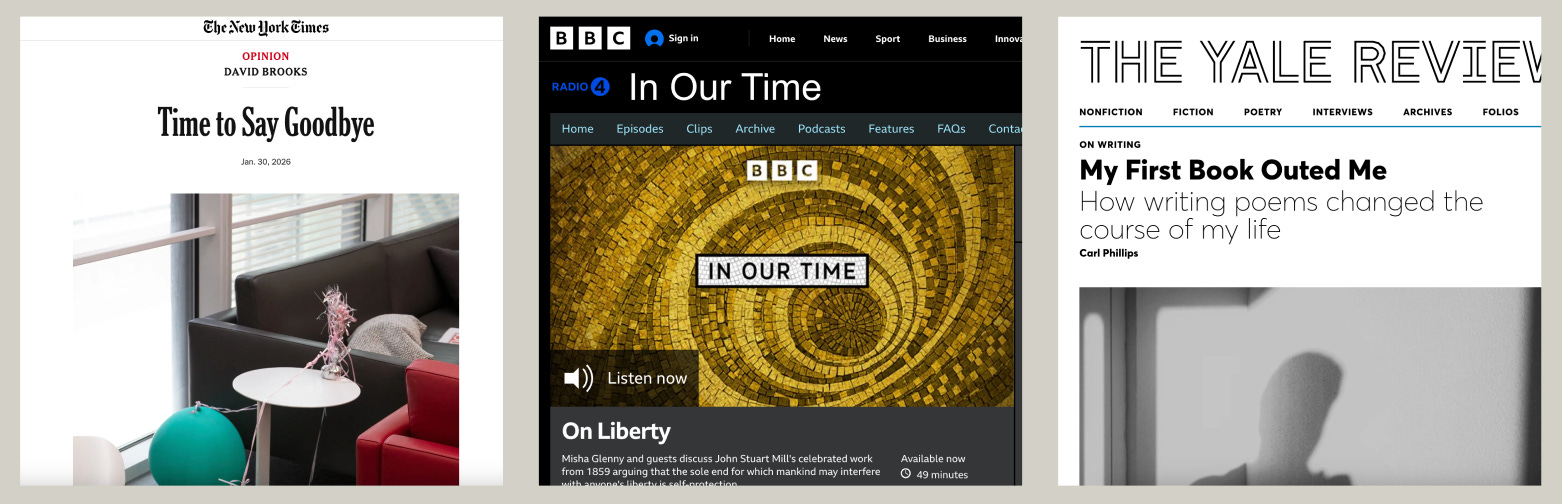
Melvyn Bragg’s In Our Time used to be my favorite radio show/podcast. I was genuinely scared the show would come to an end when Bragg retired last year, and I’m relieved it’s continuing this year with a new host, the author and historian Misha Glenny. The first episode came out yesterday (February 12) and looks into John Stuart Mill and his landmark work On Liberty. Listen
+ upcoming episode topics include The Mariana Trench, The Roman Arena, Henry IV Part 1, and The Code of Hammurabi.
After 22 years as a NYT columnist, David Brooks writes his final op-ed. The result is a profound understanding of American identity and the value culture has on shaping its future: “We have widened personal freedom but utterly failed to help people answer the question of what that freedom is for.” Read
The poet Carl Phillips opens up about teaching himself to write poetry, his first encounter with William Carlos Williams, and the impact Williams’ poetry collection had on his life: “A poem seemed a space to store a secret, and I had plenty of secrets. I began then to write the poems that would become my first book—though if I’d known that, I wouldn’t have written them.” Read
The Harvard scholar Mark Ray Lewis recently translated A Tale Told to the Darkness, a short story by Rainer Maria Rilke about being present. Read
In light of Namwali Serpell’s upcoming book On Morrison (to be published by Hogarth Press on February 17), the Nation has published an excerpt of one of her essays where she offers a new reading of Toni Morrison’s first novel The Bluest Eye. Read
Bella Freud’s cousin Emma Freud also has a story to tell. In the Observer, Emma remembers how a plant brought her closer to her great-grandfather: “So there I was, moving from apathy to disbelief, holding the same plant my great-grandfather Sigmund had nurtured nearly 100 years ago.” Read
Hermione Lee reviews Francesca Wade’s Gertrude Stein: An Afterlife for the New York Review of Books. Read
After a three-year break, the investigative journalist Glenn Greenwald is back on Substack. I’ve been following Greenwald since Edward Snowden handed him the confidential documents that would lead to the global surveillance disclosure by the Guardian. Greenwald later co-founded the nonprofit news organization The Intercept, which he resigned from in 2020 after a dispute with its editors. I’m pleased to see him kick-off with a video on Howard Lutnick and the Epstein files. Watch
Four Essays and Two Lectures I Recommend This Week
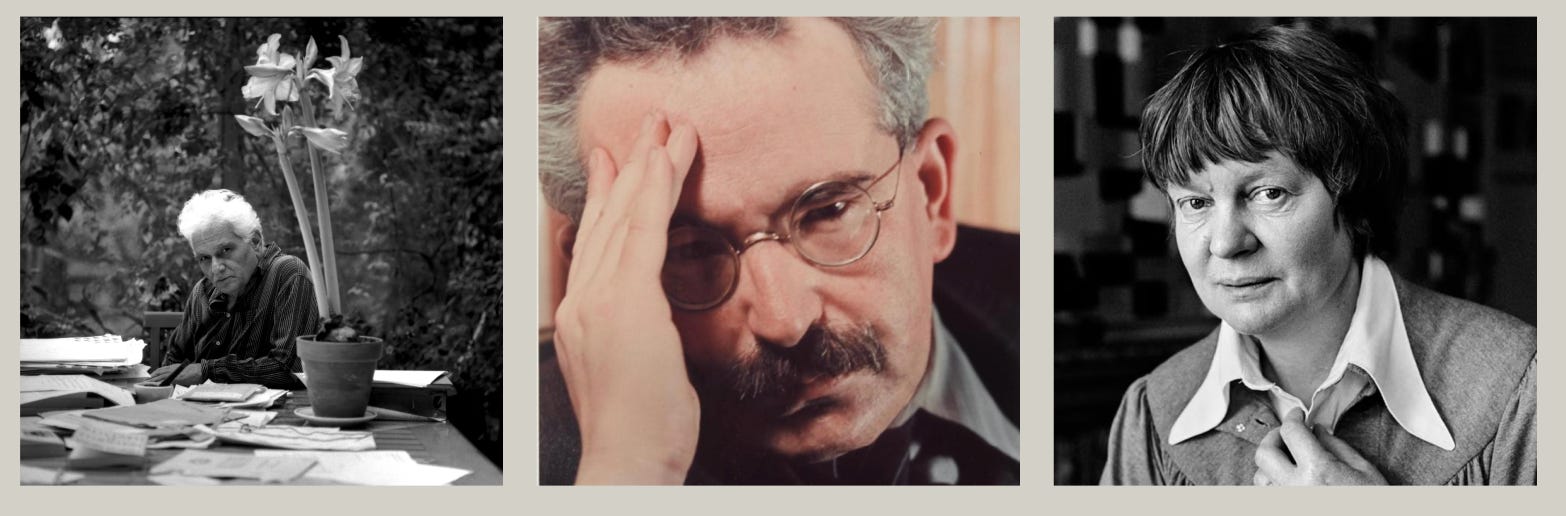
Jung’s View of Christianity by C. G. Jung. Read
Ethics of Principle versus Sensitivity by Richard Rorty. Watch
Archive Fever by Jacques Derrida. Read
The Work of Art in The Age of Mechanical Reproduction by Walter Benjamin. Read
The Generation of Postmemory by Marianne Hirsch. Read
Postmemory describes the relationship of the second generation to powerful, often traumatic, experiences that preceded their births but that were nevertheless transmitted to them so deeply as to seem to constitute memories in their own right. Focusing on the remembrance of the Holocaust, this essay elucidates the generation of postmemory and its reliance on photography as a primary medium of transgenerational transmission of trauma. Identifying tropes that most potently mobilize the work of postmemory, it examines the role of the family as a space of transmission and the function of gender as an idiom of remembrance.
Sublime & the Beautiful Revisited by Iris Murdoch. Listen
My Morning Read
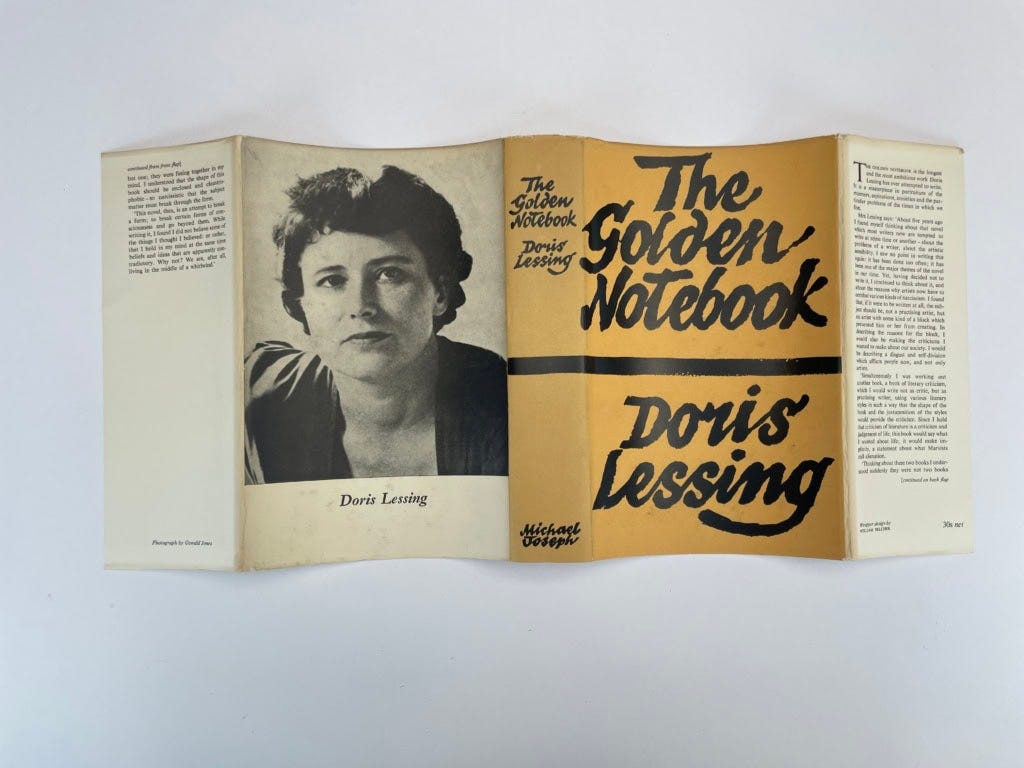
I’m not sure my therapist was being ethical (and neither was he) when he told me to read Doris Lessing more than ten years ago. Regardless, I never did. Let’s see where The Golden Notebook takes me. Every time I start on a new author I hope to find romance (I’m very often disappointed, I’m as much of a picky reader today as I was a picky eater more than thirty years ago). I hope I fall in love, and if I don’t I still win—there’s nothing like starting the day with a woman’s voice.
My Daughter’s Evening Read
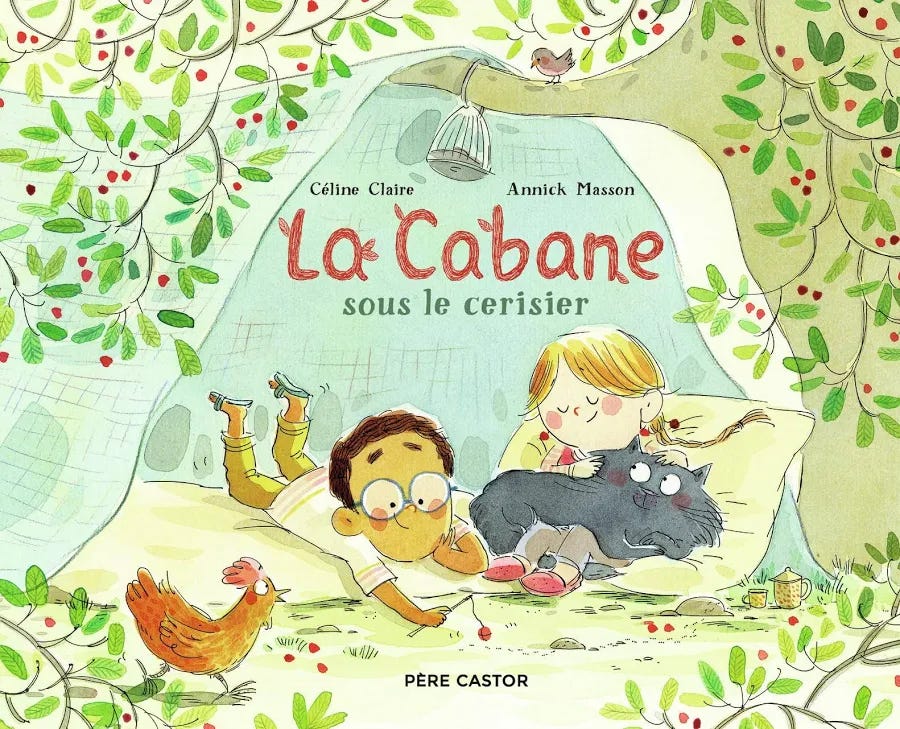
Vita is letting me read to her in French again, and this book is on repeat. La Cabane sous le cerisier tells the story of two cousins who build a tent in their grandmother’s backyard but struggle with the ants, cats, and chickens invading their set-up. The story ends with a sweet lesson about respecting nature.
What My Husband is Listening To
A Movie I’m Thinking About
The Wind Will Carry Us by Abbas Kiarostami
A Poem
The Art of Poetry by Jorge Luis Borges
To gaze at a river made of time and water
And remember Time is another river.
To know we stray like a river
and our faces vanish like water.
To feel that waking is another dream
that dreams of not dreaming and that the death
we fear in our bones is the death
that every night we call a dream.
To see in every day and year a symbol
of all the days of man and his years,
and convert the outrage of the years
into a music, a sound, and a symbol.
To see in death a dream, in the sunset
a golden sadness—such is poetry,
humble and immortal, poetry,
returning, like dawn and the sunset.
Sometimes at evening there’s a face
that sees us from the deeps of a mirror.
Art must be that sort of mirror,
disclosing to each of us his face.
They say Ulysses, wearied of wonders,
wept with love on seeing Ithaca,
humble and green. Art is that Ithaca,
a green eternity, not wonders.
Art is endless like a river flowing,
passing, yet remaining, a mirror to the same
inconstant Heraclitus, who is the same
and yet another, like the river flowing.
I’ve only recently discovered Murdoch, but after reading The Sea, The Sea and now being in the middle of The Black Prince, I already want to read all of her books. I love the barbed, caustic humour in her novels. I’m not sure whether she intended it to be so funny, but it is.
I had to copy that Borges poem into my notebook.