

Who We Are Before the World Happens
Plus Jhumpa Lahiri, Taffy Brodesser-Akner, Jorge Luis Borges, and Vladimir Nabokov.

In this week’s newsletter: several articles and essays I read this week including Jhumpa Lahiri on Thomas Hardy for the Yale Review, Taffy Brodesser-Akner’s critique on vacation for the New York Times Magazine, Virginia Woolf on air raids, and Mahmoud Darwish’s essay Exile’s Poet. Plus a visual library and a chronicle I wrote.
Chronicle
The Black Scarab
Once, I turned a black scarab beetle upside down. Then gently, I flicked him and watched him spin in circles. I could’ve gone into my mother’s pantry, found a jar and kept him in my room, but I wanted him to be able to go. I flicked him again. This time I left it to chance to bring him back to his feet, but it didn’t happen and I decided to leave him like this on the balcony. The next day after school I visited him, he was still there and I lamented his condition. The day after too, and then he died.
That Saturday, my grandmother came over to babysit me. We were on the balcony working on her crochet napkins when the phone rang. We put down our yarn and needles and hurried inside. It was her sister Rosa. Their eldest sister had been murdered at the train station, she was stabbed more than 19 times on her back. My grandmother fell to the floor. I called my father. I remember nothing of the next few days.
At that time, I already had a dreamlike habit of extending stories in my head. I liked listening to music lying on my back on our living room carpet. I’d play the same song on repeat stopping to relisten to each line. Once I had converted the entire song—each line, each melody—into a seamless sequence of images, I’d let myself listen to the whole song uninterrupted. It was a constraint I adopted in my experience with reading. Until my fifth grade teacher taught me to check-out books from the library, the only book I read was the Bible; when I made my first library card I spent my school breaks reading Nancy Drew on a red leather bean bag in the hallway. I couldn’t rely on my parents for new stories: we rarely went to bookstores and we never went to a library. So I read the Bible, the only book on my nightstand, and when the stories became insufficient, I dreamed of Abel’s life had there been no Cain or of Noah’s ark sinking in the sea.
The week after my great aunt died, during one of these afternoons, I had a reflux sensation where something started gargling in my throat. I felt like I was choking and the only way out of it was to get what was choking me out. I ran to get paper. Lying on that carpet I spat out whatever it was that was sitting there, and it went something like this:
Pam, Pam, Pam, Pam (Beethoven’s 5th symphony)
a baby is born
Pam, Pam, Pam, Pam (hospital machinery)
a woman is dying
My mother chose my name because it means rebirth in Latin. She converted the year I was born. Her born-again experience took such proportions she decided to name me on its behalf. Her rebirth was my paralysis, when I was born she transformed into my child. Like the scarab under my hold, I existed only as far as the limitations of her existence. My nature had no power before her, and I too had no place to go.
There was a time when the Egyptians believed in many Gods, when they believed Khepri—the scarab-faced God—pushed the sun across the sky each morning, just like scarabs push dirt balls across the earth. Our mothers push us into the world. We are taught, shaped, structured, measured, our barbarian ways are paralyzed. My mother believed in one God, the one that was reborn today to save his children from their sins. Who I was before the world happened to me felt impossibly distant for many years, yet the truth was never far from my reach, I just needed to find the will to turn around and see it.
New Books
Why I’m Reading These Books
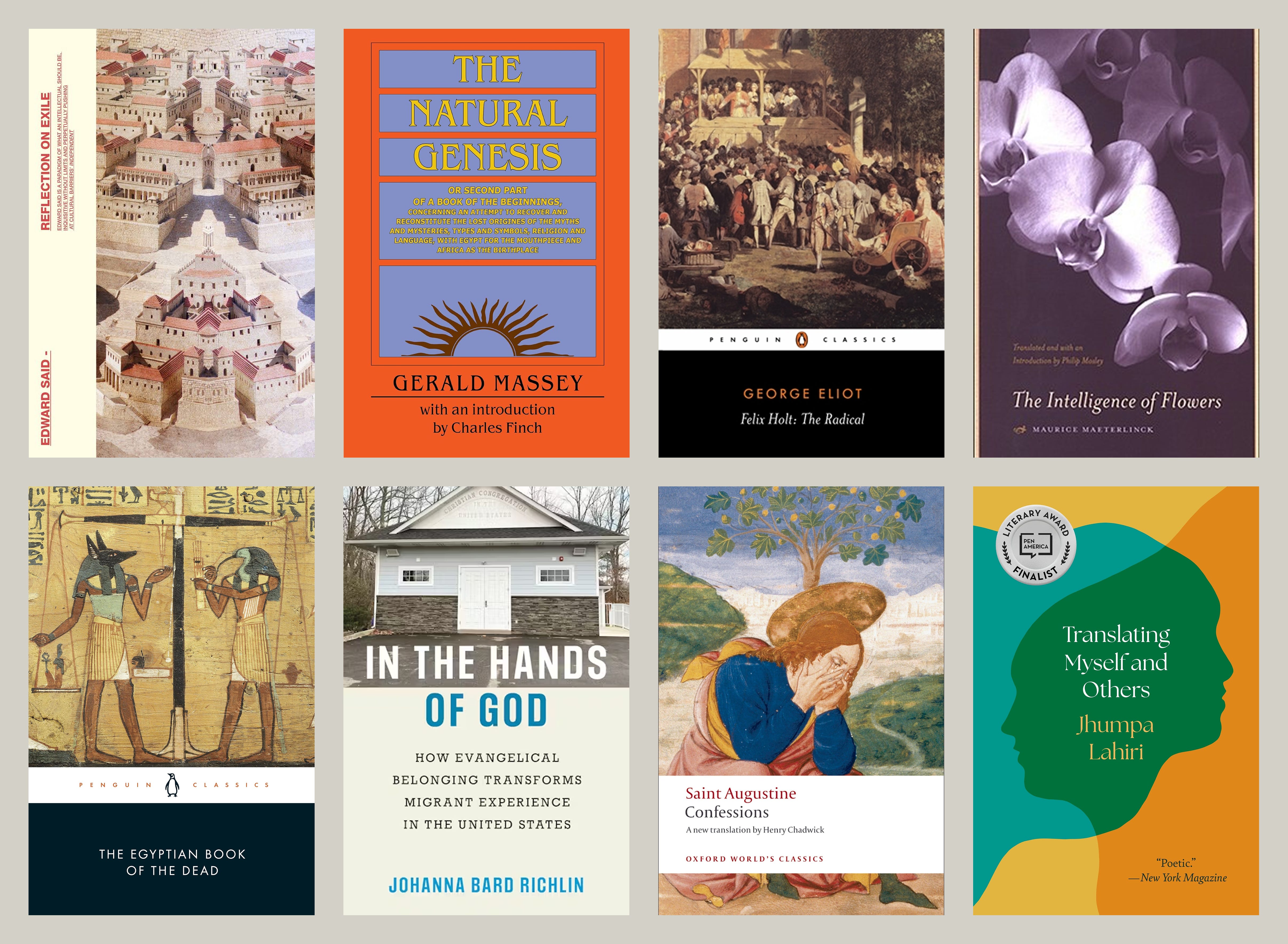
Reflections on Exile and Other Essays by Edward W. Said
Because as a child, Edward Said moved many times between Egypt and Palestine, only to settle outside of his home country in America. Having moved back and forth between America and Brazil, and only settling in France, I find solace in his experience and I’m curious to see the impact his upbringing had on his thinking.
The Natural Genesis by Gerald Massey
Because this work on the intersection of Christianity and Ancient Egypt was very controversial when it was published. I’m curious to see why and how Massey became such a polemical figure.
Felix Holt: The Radical by George Eliot
Because it’s said George Eliot’s Felix Holt was based on Gerald Massey.
The Intelligence of Flowers by Maurice Maeterlinck
Because I came across a quote in one of my old notebooks from when I first read this book and it left me wanting to read it again. It’s a short book, an easy read, and it always inspires me.: “it is the law that condemns it [the plant] to immobility from its birth to its death.”
The Egyptian Book of the Dead
Because it’s part of the research I’m doing on Egyptian mythology.
In The Hands of God by Johanna Bard Richlin
Because my experience moving to the United States with an evangelical mother determined my life experience. When a book with this kind of research comes out, I can’t resist it. It’s a strong reminder that I’m not alone.
Saint Augustine Confessions
Because I always wanted to read the Confessions, but I also always wanted to be guided through it. After reading some of the essays Garth Greenwell wrote last year while teaching this book, I felt like I could finally tap into it without feeling alone. I’m looking forward to reading it and listening to his master class Mysticism for Writers.
Translating Myself and Others by Jhumpa Lahiri
Because I admire Jhumpa Lahiri’s strength as a person. Ever since she moved to Italy and taught herself to write in Italian I have a newfound admiration for her. I’m very curious to see what she says about translation, particularly after having translated numerous Italian short stories. If you haven’t read this The Penguin Book of Italian Short Stories, it is a wonderful compilation she edited that includes Calvino, Buzzati, Svevo, Moravia, Lampedusa, Ginzburg, the list goes on.
The Visual Library
Ancient Egypt


Currently at Rue de Chabrol
Six Articles I Recommend This Week + One Short Story
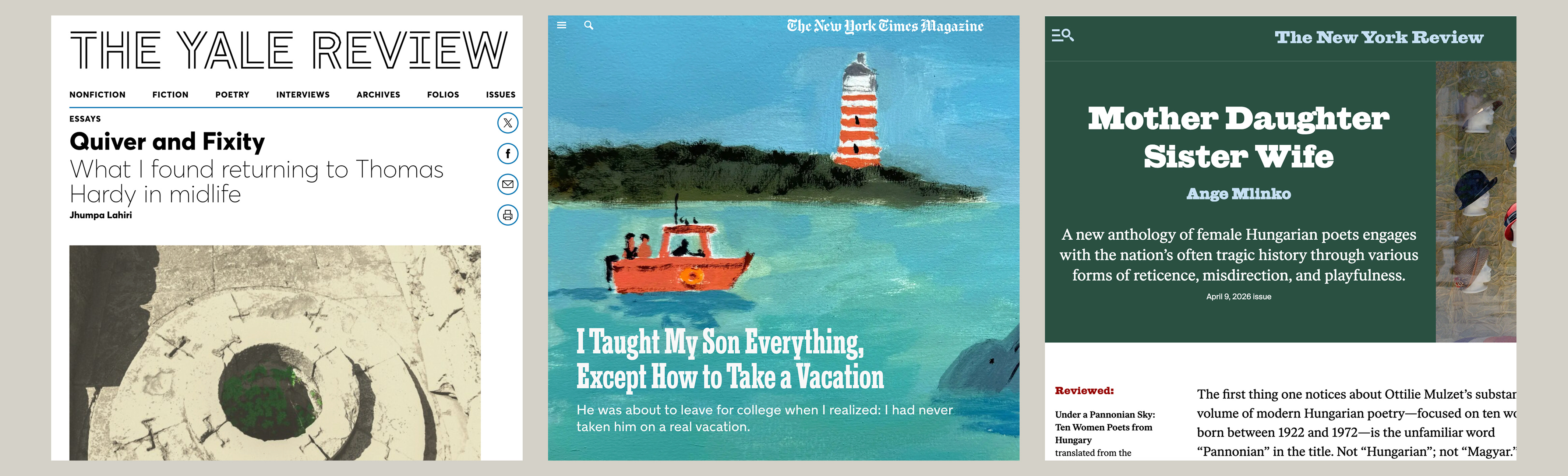
For the Yale Review, Jhumpa Lahiri writes about rereading Thomas Hardy’s Jude the Obscure. Read
For decades, I had looked to Hardy as a pillar of realism. On this rereading of Jude, the novel turned into a ghost story, an example of the fantastic.
Taffy Brodesser-Akner’s I Taught My Son Everything, Except How to Take a Vacation in the New York Times Magazine is a story about motherhood and a compelling critique on what it means to take a vacation today. Read
Tamara Sanderson writes about the psychological delusion that tormented many men in the 14th century, when they believed parts of their bodies were made of glass. Read
The physicians André Du Laurens and Alfonso Ponce de Santa Cruz independently documented a nobleman who believed himself to be shaped specifically like a glass pitcher. Not merely made of glass, but also contained by it: he slept buried in straw, terrified that he might tip in the night and pour himself out across the floor.
The American poet Ange Mlinko reviews Under a Pannonian Sky, a new anthology of female Hungarian poets born between 1922 and 1972. When László Krasznahorkai won the Nobel Prize last year, I was ashamed to admit I had never read any works by Hungarian writers. Mlinko’s review in the NYRB is a great introduction. Read
You may have read Merve Emre’s essay The Critic as Friend in the Yale Review last year, or listened to her podcast The Critic and Her Publics, or come across one of several essays she’s written for the New Yorker on Goethe or Milton. If you’ve been following Emre’s work, you might enjoy this brief interview. Read
In The American Scholar, Bill Hayes writes about the notes his late partner Oliver Sacks wrote in the margins of books and essays. Read
In Immanuel Kant’s Prolegomena to Any Future Metaphysics (1783), Oliver sounded almost comically exasperated as he responded to a rambling critique Kant makes of David Hume (whom Oliver revered): “Immanuel,” he wrote, as if speaking directly to the philosopher across the centuries, “you are totally confused!”
Will Hall’s short story Love Language in the Drift. Read
Six Essays I Recommend This Week
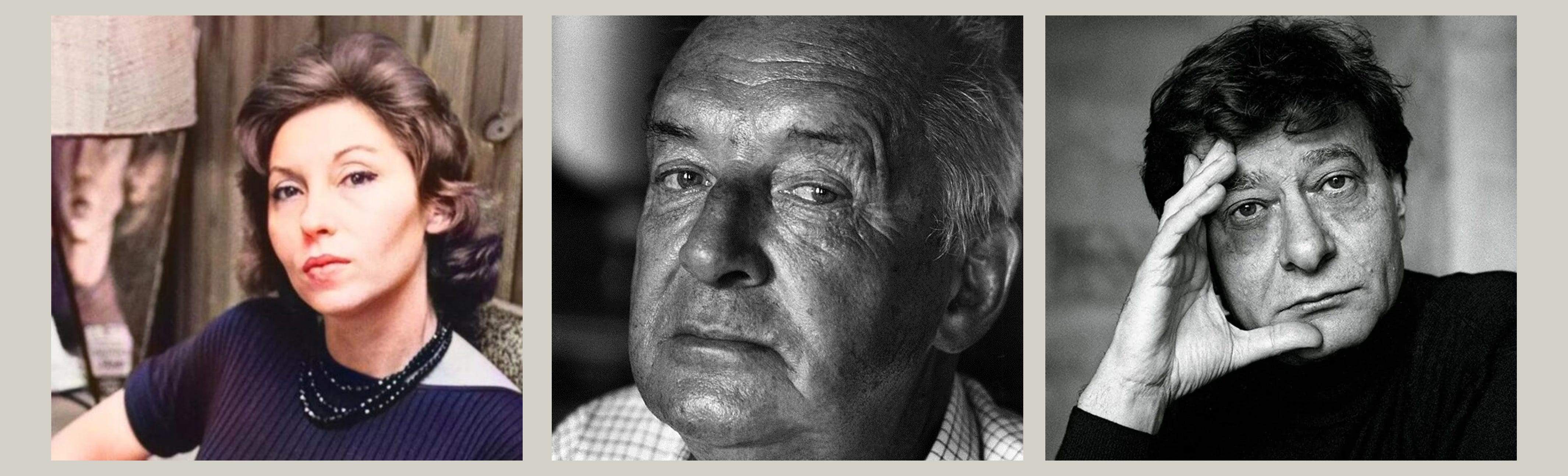
Thoughts on Peace in an Air Raid by Virginia Woolf. Read
Unless we can think peace into existence we—not this one body in this one bed but millions of bodies yet to be born—will lie in the same darkness and hear the same death rattle overhead.
Why Go Out? by Sheila Heti. Read
In Favor of Fear by Clarice Lispector. Read
Exile’s Poet by Mahmoud Darwish. Read
Good Readers and Good Writers by Vladimir Nabokov. Read
A History of Eternity by Jorge Luis Borges. Read
My Morning Read
The Story of Egypt by Joann Fletcher.
My Daughter’s Evening Read
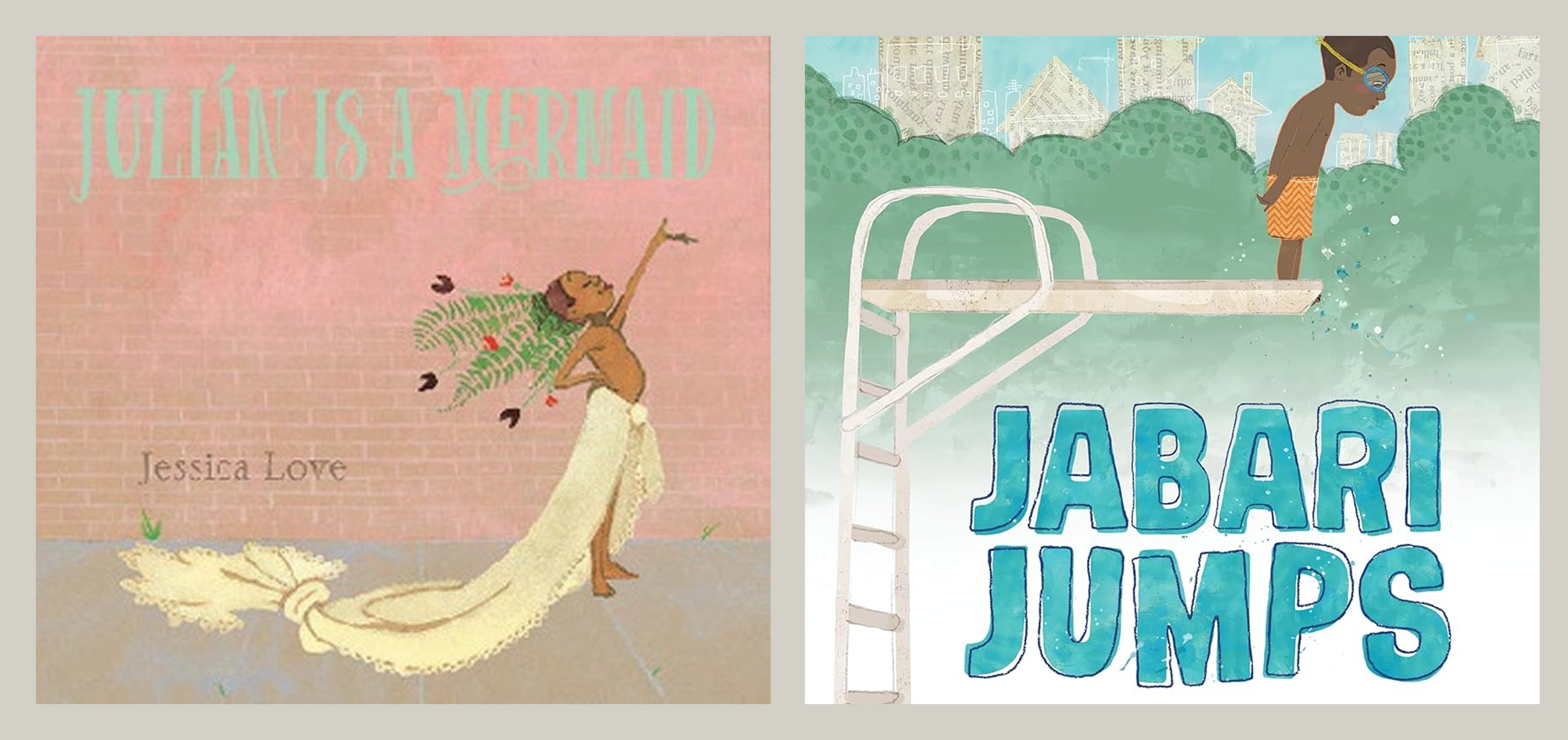
We’re a bit stuck… Vita is reading less than before and I’m hoping it’s just another one of those phases, but being the intense and panicked mother that I am, I haven’t been able to take this lightly. I’ve been doing large amounts of research on finding the right books for her and having them sent from Amazon in America to France (please forgive me, but children’s English bookstores in France are not cutting it right now). Anyway, I think I found a way in, I noticed she’s into stories she can relate to… She loves Jabari Jumps, because it’s about overcoming your fears, and Julian is a Mermaid, a queer story about being whoever you want to be. She’s nearly five years old, and if you have any recommendations I would be so grateful.
What My Husband is Listening To
Jeune Morty Vol.1 by Jeune Morty
A Movie I’m Thinking About
Cave of Forgotten Dreams by Werner Herzog
A Poem
He would not stay for me, and who can wonder by A. E. Housman
He would not stay for me, and who can wonder?
He would not stay for me to stand and gaze.
I shook his hand, and tore my heart in sunder,
And went with half my life about my ways.
The Ana Ana books are wonderful! Originals in French but there may be translations now: https://www.amazon.com/Ana-12-veux-être-princesse/dp/2205077880
I recently came across this children's book (which I was shocked I'd never heard of) and I think it has the most charming premise! https://www.simonandschuster.com/books/Six-Dinner-Sid/Inga-Moore/9780671796136