

There needn’t be more than there already is
Plus film recommendations for the summer and a poem by Hart Crane.

Welcome to Rue de Chabrol. In this week’s newsletter: several articles and essays I read including Marguerite Duras and Walter Benjamin for the Paris Review, Emily Wilson on Christopher Nolan’s screen adaptation, and Jack Hanson’s cover essay for Harper’s magazine. Plus a chronicle I wrote and the films I’m watching over summer break.
CHRONICLE
Summer Afternoon
There was an unsaid appreciation for leaving the table with your hands full. It was a task everyone partook in after lunch and we did it with thoroughness. We cleared the table, washed the dishes, and wiped the counters. My daughter went off to play with her dad and her mamy, while her papy went outside to tend the garden. That left me alone to vacuum and I was content with my task. Summer lunch was an ordeal. Everyone believed in gathering around a perfectly set table, in front of a healthy spread that was meant to please. Eating properly was non-negotiable, and since neither mamy nor I liked to cook, it was understood that we’d keep organized with a consistent menu. We were never short of cherry tomatoes for her son or grilled duck for the little one. My daughter sat through lunch politely, if only to make sure she could have dessert. And before we served the ice cream, with fresh-picked figs and blackberries, we paused for a smoke and a cup of coffee. It was papy’s time to have cheese.
It was a relief to vacuum the floor, vacuuming gave me time to think, and if I was going to write anything this summer, I had to think about it. The best place for this kind of reflection was always at home, I thought best when my husband was at work, my daughter at school, and I could sit with a notebook. There wasn’t a chance I would be at my desk this time of year. It was summer, school was out, and I was in the South of France with my in-laws. This didn’t mean I would have any respite from those childhood memories that came to visit me each day. Those fragments were always rubbing my mind tired, and I always had to find the best way to counteract them. I kept what rang the loudest, whatever came with the most force. I thought of the stories I read, the ones that taught me to make something whole out of these fragments, how much I wished they were mine.
Then my daughter came to me in the kitchen, pulled on my dress and asked to vacuum too. She put her feet on top of mine, with one arm I held her around my body, and together we moved the vacuum to its home in the pantry. I was ready to go upstairs and write.
Now, what was I thinking about? That story I read earlier that week. I need something more elusive. What about the baby bird we found. No. I looked out of the window, to the tops of the trees still pink with flowers. I thought of a scene in a novel I recently read, where a man was sitting on the train in the direction he described as facing the past. Just a few weeks ago, when I was also traveling in this direction on the train, I felt a profound nausea and all I could do was revisit this line time and again until the ride was over. There’s something there, perhaps something to do with those glimpses of memories that come to stab me out of nowhere.
On the train, I started, when I face everything we’ve passed. There must be a more sickening way of saying I face the past, afterall I was on the train, what made me nauseous was not to move away from my past, but to be forced to look at it, when I face what passed. It still feels optional. But I have a full sensation, I’m stabbed, shocked, I’m taken somewhere else, I hold my left thigh against my chest. I hear my daughter. On the train, when I face what passes, I feel sick, helpless. There, that was going to be it for now.
Every day, when I’m out for a walk, memories from my childhood hit me like a cold front. When I’m walking I can run, jump into a store, turn around and go home. On the train, when I’m rear-facing, I have no option but to face the past. I put my legs up and down. I open a book and I close it. I’m frantic and helpless. I close my eyes and I’m too hot. I get up to pee but I’m still sick. I’m sick of looking at the place I need to escape from.
I felt guilty not saying goodbye before she left for her afternoon swim lessons with her father and mamy. I stop to send her off. She’s so tall now. I help her climb up a stool, I grab her and give her a spinning hug full of little kisses on her cheek and she smiles, her two front teeth bite over her lower lip. She’s holding her father’s hand now and she’s outside walking to the car. Past the sunflower fields she hears the noise, she looks at me and says “mom, the train, the train, it’s passing”.
I think of something to make happen, like in the story I read, but I come to a stop, that story can’t give me any more than what I already have. I can’t add a man, a dog, a fight, values and principles, none of that happens on that seat on the train. I hold my shoulders with opposite hands. I turn the pages of a notebook. I twist my legs around each other. There needn’t be more than there already is.
I went downstairs to tidy the house before everyone came back. I decided to go to the market to pick-up fresh vegetables for dinner. Nothing was less eventful than going to the food store, knowing each vegetable in my cart was a task waiting for me at the house. Peeling oranges, cleaning crumbs off the floor, slicing potatoes, seasoning green salads. Tomorrow I’ll try again.
VISUAL LIBRARY
Green Screen


TOP SHELF
Summer Films
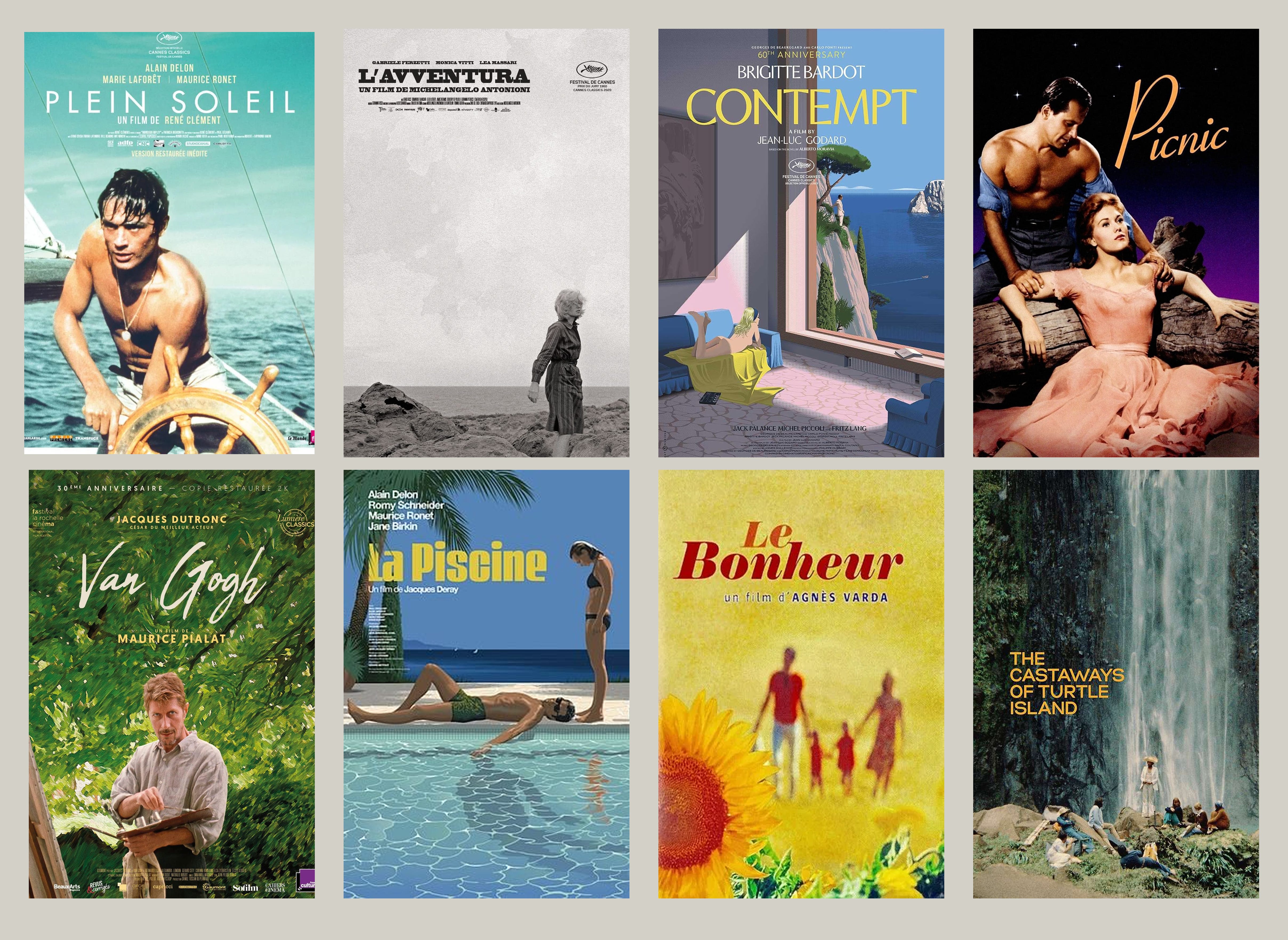
Eight films I’m watching this summer.
Plein Soleil with Alain Delon. Directed by René Clément. 1960. Trailer
L’Avventura with Monica Vitti. Directed by Michelangelo Antonioni. 1960. Trailer
Contempt with Brigitte Bardot. Directed by Jean-Luc Godard. 1963. Trailer
Picnic with Kim Novak. Directed by Joshua Logan. 1955. Trailer
Van Gogh with Jacques Dutronc. Directed by Maurice Pialat. 1991. Trailer
La Piscine with Jane Birkin and Alain Delon. Directed by Jacques Deray. 1969. Trailer
Le Bonheur. Directed by Agnès Varda. 1965. Trailer
The Castaways of Turtle Island with Jacques Villeret. Directed by Jacques Rozier. 1976. Trailer
AN EXCERPT
from The Waves by Virginia Woolf
“As summer neared, as the evening lengthened there came to the wakeful, the hopeful, walking the beach, stirring the pool, imaginations of the strangest kind- of flesh turned to atoms which drove before the wind, of stars flashing in their hearts, of outwardly the scattered parts of the vision within. In those mirrors, the minds of men, in those pools of uneasy water, in which cloud forever and shadows form, dreams persisted; and it was impossible to resist the strange intimation which every gull, flower, tree, man and woman, and the white earth itself seemed to declare (but if you questioned at once to withdraw) that good triumph, happiness prevails, order rules, or to resist the extra ordinary stimulus to range hither and thither in search of some absolute good, some crystal of intensity remote from the known pleasures and familiar virtues, something alien to the processes of domestic life, single, hard, bright, like a diamond in the sand which would render the possessor secure. Moreover softened and acquiescent, the spring with their bees humming and gnats dancing threw her cloud about her, veiled her eyes, averted her head, and among passing shadows and fights of small rain seemed to have taken upon her knowledge of the sorrows of mankind.”
IN THE NEWS
Reading Material
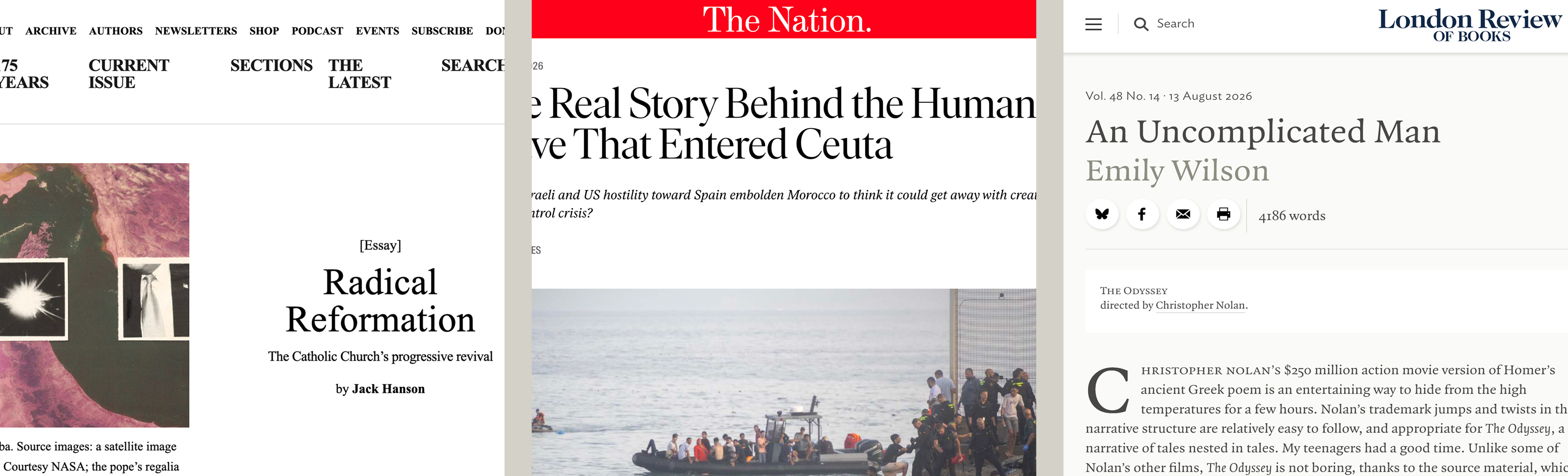
In Jack Hanson’s cover essay for the August issue of Harper’s, he analyzes the catholic church’s new position. Read
We are witnessing the flowering of tendencies that have long gestated within both the clergy and the laity, a long-neglected voice speaking to a world that, in a moment of profound instability, seems desperate to hear it.
Everything you need to know about the Cambridge Professor Jason Arday being accused of plagiarism. Read
“There is a well-documented playbook for discrediting Black academics in high-profile positions, and it’s been used to devastating effect in the U.S. and now with me in the U.K.,” he said in the statement. “My greatest hope is that what is happening to me now will serve to further expose these actors and forces.”
Professor Stephen Zunes looks at the backstory that led to the Moroccan invasion in Ceuta, Spain. Read
The recent border crossings, therefore, were neither a genuine humanitarian crisis nor part of an anti-colonial struggle, but part of efforts by the growing US-Israeli-Moroccan nexus—codified and strengthened by the so-called Abraham Accords—to weaken a progressive European government, divide Europe, and undermine international law and human rights.
Sheila Heti’s new short story in the New Yorker Earthly Delights. Read
In the latest issue of the London Review of Books, Emily Wilson criticizes Christopher Nolan’s screen adaptation of the Odyssey, (“It’s a family-friendly audiovisual spectacle, like an elaborate Fourth of July fireworks display – and with about the same level of narrative and emotional depth.”) but remains grateful: (“Nolan, who studied English at University College London – where students still study The Odyssey as a first year ‘foundational text’ – is doing his best to get the general public reading again, and I am grateful.”). Read
THIS WEEK’S ESSAYS, STORIES, AND INTERVIEWS
Written Material
I’ve been taking some time to read through the Paris Review archives, which as you know are a gold mine. Here are some pieces I read and enjoyed.
“Motherhood Makes You Obscene” by Marguerite Duras. Read
“Don’t Read and Eat” by Walter Benjamin. Read
An Interview with John dos Passos. Read
“The Werewolf” by William Faulkner. Read
“The Saint” by Gabriel García Márquez. Read
An Interview with Nathalie Sarraute. Read
CURRENTLY AT RUE DE CHABROL
My Morning Read
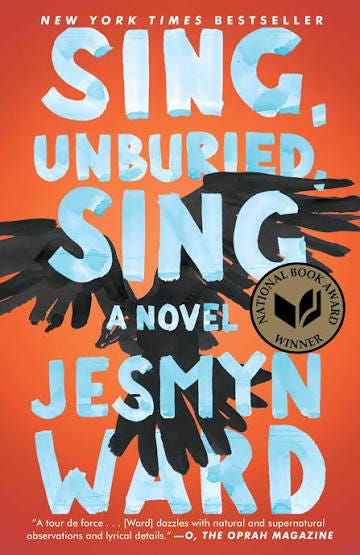
Sing, Unburied, Sing is one of the books I chose to read for my American South summer. I don’t understand how I waited so long to read it. Jesmyn Ward’s writing is refined, her dialogues are meticulous and feel alive, I hear Jojo and Leonie loud and clear, I don’t even feel like I’m reading.
What My Daughter’s Reading
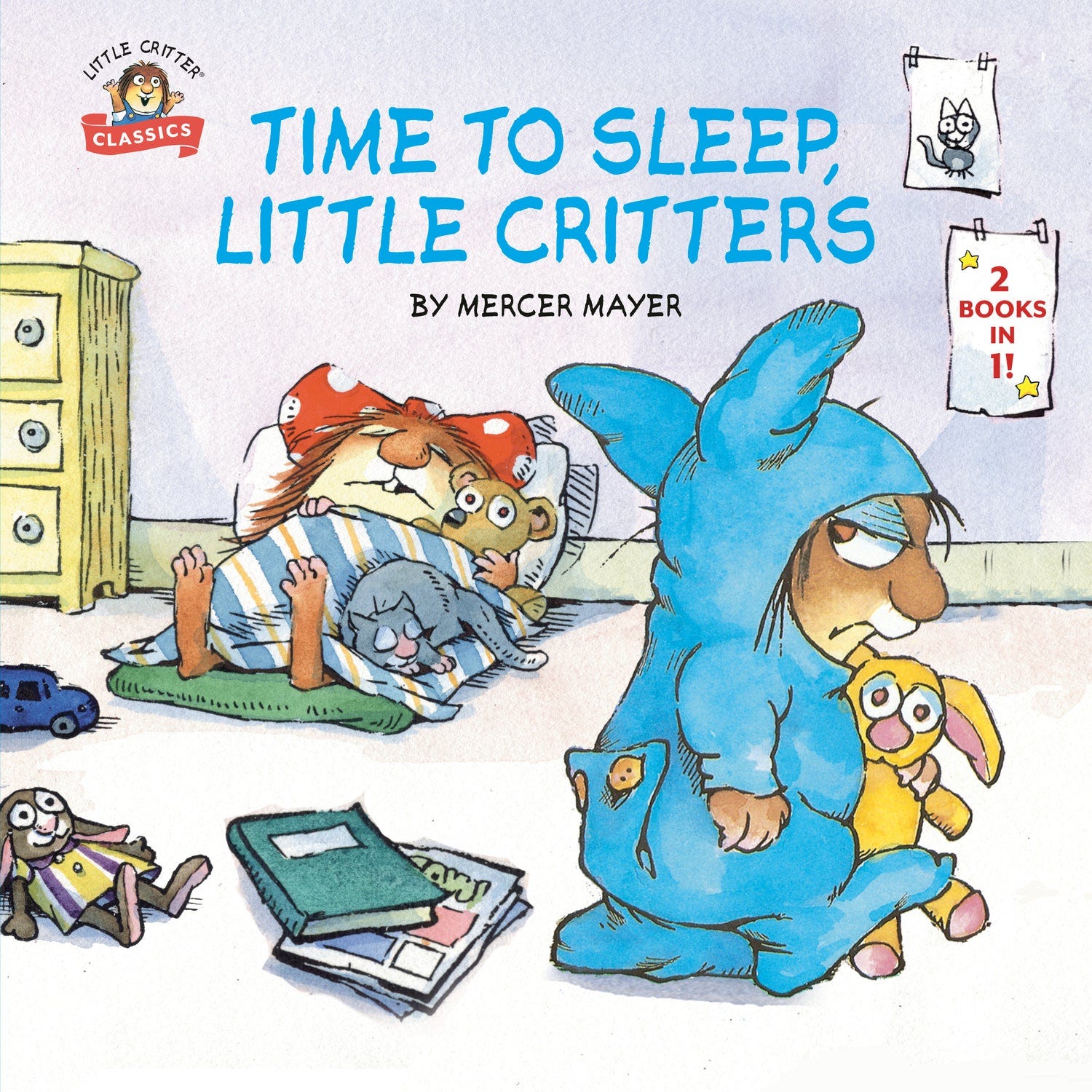
When I was four and we first moved to America, our neighbor brought over a box of book for my older brother. He didn’t care for anything inside besides the comic books, but I would spend hours flipping through the images in all of them. Mercer Mayer was a standout. I loved looking through her Little Critters collection. Last time we were in America, I got a copy of this one for Vita, but we forgot it at my in-laws’ house. Last night we came across it and read it together. We love it.
What My Husband’s Listening To
“Rituals of the Last Dawn” by the Iranian musician Saba Alizadeh.
A Movie I’m Thinking About
Kenneth Clark’s 1969 “Civilisation: A Personal View”, where in a series of 13 episodes the English art historian outlines the history of art and human thought from the Dark Ages to the 20th century. When it came out, 2.5 million people watched it in Britain and 5 million in the United States. The critic Morgan Meis reviewed the series in 2016 for The New Yorker.
FINAL POEM
The Air Plant
by Hart Crane
Grand Cayman

This tuft that thrives on saline nothingness,
Inverted octopus with heavenward arms
Thrust parching from a palm-bole hard by the cove⎯
A bird almost⎯of almost bird alarms,

Is pulmonary to the wind that jars
Its tentacles, horrific in their lurch.
The lizard’s throat, held bloated for a fly,
Balloons but warily from this throbbing perch.

The needles and hack-saws of cactus bleed
A milk of earth when stricken off the stalk;
But this,⎯defenseless, thornless, sheds no blood,
Almost no shadow⎯but the air’s thin talk.

Angelic Dynamo! Ventriloquist of the Blue!
While beachward creeps the shark-swept Spanish Main
By what conjunctions do the winds appoint
Its apotheosis, at last⎯the hurricane!